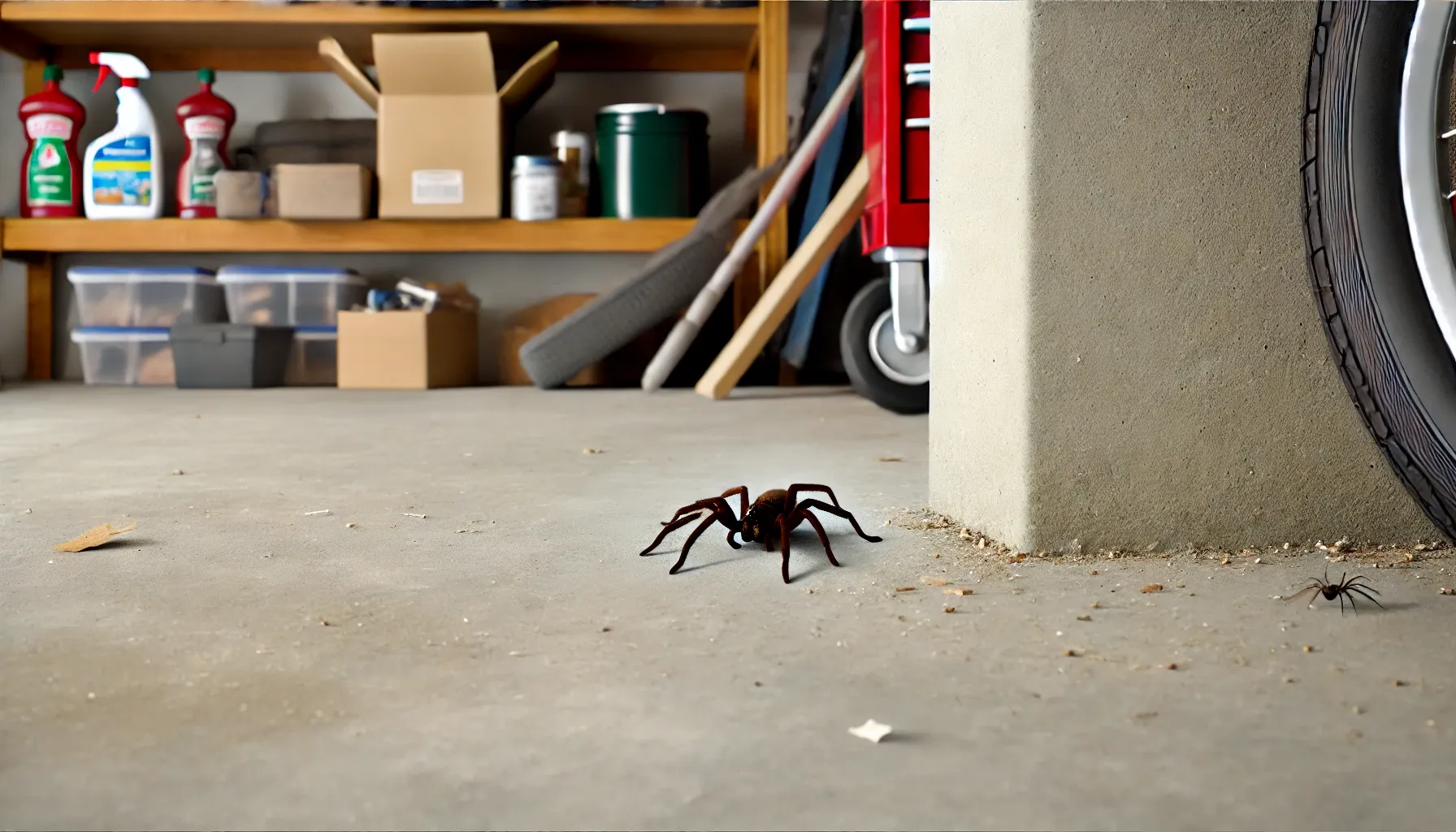
The giant house spider (Eratigena duellica) is the big, fast, brown spider that shows up on basement floors and in bathtubs across western Oregon and Washington every late summer. It looks alarming, but it isn't dangerous: its bite is not known to pose any threat to people, and it would much rather run than bite. Most of the ones you see out in the open are males looking for a mate.
Quick facts
| Scientific name | Eratigena duellica (Simon, 1875), family Agelenidae, the funnel weavers |
|---|---|
| Older names | Tegenaria gigantea, Tegenaria duellica and Eratigena atrica |
| Body length | About 1/2 inch to 1 inch, not counting the legs |
| Leg span | Up to about 4 inches on large adults |
| Color | Brown to grayish-brown, a little hairy, never shiny |
| Web | A flat sheet of silk with a funnel at one end, in dark, quiet spots |
| When you see them | Mid-summer to early fall, mostly wandering males |
| Bite | Not known to pose any threat to humans |
| Range | Mostly west of the Cascades in Oregon, Washington and British Columbia; less common east of the mountains and in north Idaho |
What is a giant house spider?
It's a funnel weaver, from the same family as the hobo spider and the barn funnel weaver. The species is native to Europe, including the United Kingdom, where it's one of the best-known fall visitors. At some point it hitched a ride to North America, and today it's firmly established in the Pacific Northwest. Washington State University (WSU) describes it as commonly found in and around homes west of the Cascade Mountains, with a range that reaches into coastal Canada and Oregon. WSU also calls it ideally adapted to life indoors.
Like most spiders, it's a predator that earns its keep. Its prey includes flies, moths, earwigs, beetles, cockroaches and even other spiders, so a basement full of giant house spiders usually means a basement full of the bugs they eat.
Why the scientific name keeps changing
Look this spider up and you'll find three or four different names. For most of the last century it was Tegenaria gigantea or Tegenaria duellica. In 2013, a large study of European funnel weavers moved it, the hobo spider and several relatives into a new genus, Eratigena. At the time, the giant house spiders were treated as one species, Eratigena atrica.
Then in 2018, arachnologists Geoff Oxford and Angelo Bolzern compared the spiders' DNA and anatomy and showed that what everyone called E. atrica was really three species. The World Spider Catalog now lists all three: E. atrica, E. duellica and E. saeva. The giant house spider in the Pacific Northwest is E. duellica. Many fact sheets, including WSU's, still use Eratigena atrica, so don't be thrown if you see both.
How to identify a giant house spider
Honest answer first: nobody can be completely sure by eye. The Burke Museum in Seattle points out that around 200 spider species in the region look alike, and telling the closest ones apart takes a microscope. A few clues still narrow it down fast.
Size and leg span
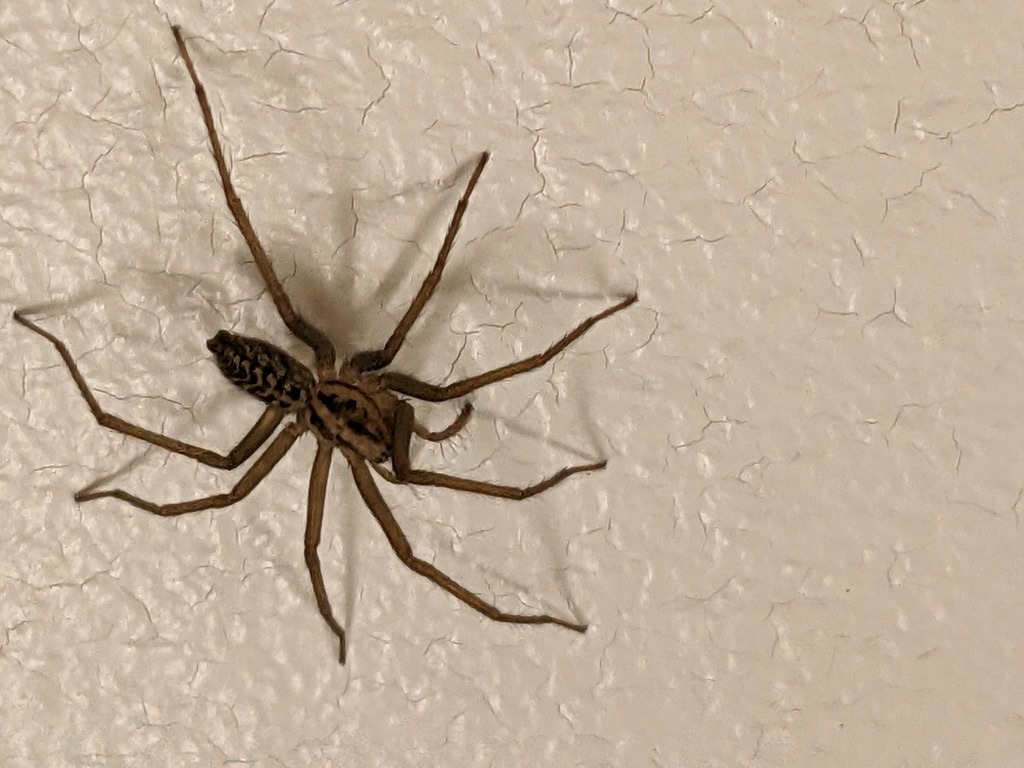
Size is the biggest clue. WSU puts the body at about 1/2 inch to 1 inch long, and the leg span of a large adult can reach 4 inches. That's wider than a credit card is long.
Color and markings
Expect brown to grayish-brown, slightly hairy and never glossy. Many have a pale stripe down the front of the body, chevron marks on the abdomen and faint bands on the legs. But WSU notes that color and markings vary so much from spider to spider that none of them are reliable for identification.
Males and females
Males have a smaller body, very long legs and two swollen palps up front that look like little boxing gloves. Every adult male spider has those (they're its reproductive organs), so they won't tell you the species, but they will tell you it's a male. Females are heavier, with a bigger abdomen, and they spend most of their lives in or near their webs.
The funnel weaver giveaway
Check the back end. Funnel weavers have a pair of long, finger-like spinnerets that stick out past the abdomen. Their eight small eyes sit in two fairly even rows across the front of the head. A wolf spider, by contrast, has two big forward-facing eyes that shine back at you in a flashlight beam.
Webs and hiding spots
The web is a flat sheet of silk that narrows into a funnel, where the spider waits for prey. The sheet isn't sticky. When an insect walks onto it, the spider feels the vibration, races out, grabs it and drags it back into the funnel.
They build in dark, quiet places that don't get disturbed much:
- Basements and crawl spaces
- Garages, especially behind stored boxes and along the bottom of walls
- Window wells and under decks
- Firewood piles
- Gaps between bricks or stones
- Closets and storage rooms that rarely get opened
Why am I seeing giant spiders in my house?
Late summer is giant house spider season, and the reason is simple. Males reach adulthood, leave their webs and go looking for females. WSU says they're most often seen from mid-summer to early fall, when males are highly mobile. So the giant house spider sprinting across your living room in September is usually a male on a road trip, not a sign that your house is overrun. He probably came up from a basement, crawl space or garage, or walked in under a door.
That also explains the bathtub. WSU notes these spiders aren't strong climbers and often get trapped in sinks and tubs while looking for water. They didn't come up the drain. The Burke Museum makes the same point: spiders in tubs came in over the edge and can't climb back up the slick sides.
Seeing one doesn't mean your house is dirty. It means there's shelter and food close by, which describes most homes in the Northwest.
Is the giant house spider poisonous?
No, and it isn't dangerous or aggressive either. Technically spiders are venomous, not poisonous: poison hurts you when you eat or touch it, while venom is injected. Nearly every spider has venom for subduing insects. According to WSU, the bite of the giant house spider is not known to pose any threat to humans, and bites are rare because the spider runs, very quickly, when it's disturbed.
The best real-world data comes from a 2014 study by doctors at the Oregon Poison Center and spider expert Rick Vetter. They collected 33 spider bites in Oregon where the spider was caught and identified. One was from a giant house spider and one from a hobo spider. None of the 33 caused significant medical symptoms or skin damage, and the hobo spider bite cleared up within 12 hours.
Any spider might bite if it's pressed against your skin, say in a glove or a pile of laundry. If that happens, wash the spot with soap and water. If a bite gets worse, spreads or won't heal, see a doctor, and bring the spider along if you caught it. Plenty of wounds blamed on spiders turn out to be something else.
Giant house spiders vs. hobo spiders, wolf spiders and brown recluses
Mixing these four up is common. Here's the short version.
| Spider | Size | Web | Where you'll see it | Bite |
|---|---|---|---|---|
| Giant house spider | Body 1/2 to 1 inch, legs up to 4 inches across | Sheet web with a funnel | Floors, tubs, basements and garages, mostly late summer | Not known to harm people |
| Hobo spider | Body about 1/2 to 5/8 inch | Sheet web, usually hidden under objects | Basements, window wells, low to the ground | Not considered medically important |
| Wolf spider | Varies; big ones rival a giant house spider | No web; hunts on the ground | Lawns, gardens and garages; wanders in when it cools off | Not considered dangerous |
| Brown recluse | Body about 3/8 inch | Loose, irregular web | Not established in Oregon, Washington or Idaho | Can be medically significant |
How to tell it from a hobo spider
This is the hard one. They're in the same genus, both brown and both funnel weavers. Size is your best clue: UC IPM puts the hobo spider's body at about 1/2 to 5/8 inch, and its legs are nowhere near the 4-inch span of a big giant house spider.
The good news is that the stakes are low. The hobo spider was once blamed for flesh-wound bites, but the research didn't hold up. UC IPM now says its bite is "not considered of medical importance," and the Burke Museum notes the CDC dropped it from its list of venomous spiders. UC IPM also reports that giant house spiders have pushed hobo spiders out of much of Seattle, and WSU says giant house spiders now outnumber hobos around Puget Sound. Our hobo spider vs. wolf spider guide has more on hobos.
How to tell it from a wolf spider
Wolf spiders are hunters. They don't build webs, they're stockier, and many have stripes running back from the eyes. The giveaway is those two big eyes glowing in a flashlight. Females drag their egg sac behind them and then carry the babies on their backs. A giant house spider has long, thin legs for its body, small eyes, and lives in a web.
How to tell it from a brown recluse
People in the Northwest worry about this one more than they need to. Brown recluses aren't established in Oregon, Washington or Idaho. They're smaller, have a violin-shaped mark on the front of the body, six eyes instead of eight, and plain legs with no bands. A big, hairy, fast brown spider in a Boise basement isn't a recluse. Here's what else it might be.
Where they live in Oregon, Washington and Idaho
West of the Cascades, giant house spiders are common in Salem, Eugene, Seattle, Tacoma and along the coast.
East of the mountains they're much less common. WSU's fact sheet says they aren't found east of the Cascades in Washington, but iNaturalist now has about 60 confirmed sightings there, mostly around Spokane and Pullman, plus a handful in central Oregon around Bend and Prineville. Idaho has just 8, all in the north around Moscow and Kootenai County, next door to Pullman and Spokane. We couldn't find a single sighting in the Treasure Valley.
So if you live in Boise, Meridian or Nampa and there's a big brown spider in the basement, it's more likely a hobo spider, a wolf spider or a barn funnel weaver. iNaturalist has dozens of confirmed hobo spider sightings in the valley. Our guide to the biggest spiders in Idaho covers the usual suspects.
How to get rid of house spiders
One spider on the floor isn't a problem you need to solve. Slide a cup over it, slip a piece of paper underneath and put it outside, or let it be. It eats other bugs. If you're seeing them every week, these steps help:
- Seal the way in. Check door sweeps and weatherstripping, the garage door seal, torn window screens, and gaps around pipes and wires.
- Clear the hiding spots. Keep boxes off basement and garage floors, swap cardboard for lidded plastic bins, and don't let clutter pile up along the walls.
- Vacuum webs and egg sacs. Run the vacuum along baseboards, under stairs and into corners, then empty it outside.
- Set sticky traps. Glue traps along basement and garage walls catch wandering males, and WSU suggests them for spiders indoors. Keep them where kids and pets can't reach.
- Watch the firewood. Stack it away from the house, wear gloves, and only bring in what you'll burn that day.
- Cut the food supply. Fewer insects means fewer spiders. Warm or yellow porch bulbs pull in fewer bugs at night.
- Close up the crawl space. Make sure the vents are screened and the access door shuts tight.
When to call a pro

Call when you're finding spiders every week, when webs keep coming back in the garage or basement, or when you'd just rather not deal with it. Spiders are covered by our general pest control service, and our spider control starts with a full de-web: webs and egg sacs come down from the eaves, windows, doors and patio. Then we treat the eaves, upper corners, door and window frames and the foundation with EPA-registered products, point out the gaps letting them in, and keep the numbers down with quarterly visits. Touch-ups between visits are free.
Giant house spider FAQ
Is the giant house spider poisonous?
No. Spiders are venomous rather than poisonous, and the giant house spider's bite is not known to pose any threat to people. It's shy and runs when it's disturbed.
Why am I getting giant spiders in my house?
In late summer and early fall, adult males leave their webs to look for females. They wander out of basements, crawl spaces and garages or come in under doors, which is why they suddenly turn up on floors and in tubs.
Is it safe to sleep in a room with a big spider?
There's no reason to leave the room. A giant house spider has no interest in people; it's looking for a mate or a quiet corner, and bites are rare. If it bothers you, cup it and put it outside before bed.
What does it mean to see a giant spider in your house?
Usually just that it's late summer. Most big spiders seen in the open are males searching for females. One now and then is normal. Seeing them every week means they have shelter and food nearby, like a cluttered garage, an open crawl space or plenty of insects.
Do giant house spiders live in Idaho?
Only in the north, around Moscow and Kootenai County. We couldn't find any confirmed records in the Treasure Valley, where big brown basement spiders are usually hobo spiders, wolf spiders or barn funnel weavers.
Should I kill a giant house spider?
You don't have to. They eat flies, moths, earwigs and other spiders. If you'd rather not share the house, catch it and put it outside or vacuum it up. If you see them all the time, seal the entry points and clear the clutter, or have a pro handle it.
Sources
- Washington State University Pestsense, Giant house spider fact sheet.
- Washington State University Pestsense, Hobo spider fact sheet.
- UC Statewide IPM Program, Hobo Spider, Pest Notes.
- Rod Crawford, Burke Museum, Spider Myths.
- World Spider Catalog, Eratigena duellica (Simon, 1875), Natural History Museum Bern.
- Bolzern, A., Burckhardt, D. and Hänggi, A. (2013). Phylogeny and taxonomy of European funnel-web spiders of the Tegenaria-Malthonica complex (Araneae: Agelenidae) based upon morphological and molecular data. Zoological Journal of the Linnean Society 168(4): 723-848. doi:10.1111/zoj.12040
- Oxford, G. S. and Bolzern, A. (2018). Molecules v. morphology: is Eratigena atrica (Araneae: Agelenidae) one species or three? Arachnology 17(7): 337-357. doi:10.13156/arac.2017.17.7.337
- Vetter, R. S. et al. (2003). Distribution of the medically-implicated hobo spider (Araneae: Agelenidae) and a benign congener, Tegenaria duellica, in the United States and Canada. Journal of Medical Entomology 40(2): 159-164. doi:10.1603/0022-2585-40.2.159
- McKeown, N., Vetter, R. S. and Hendrickson, R. G. (2014). Verified spider bites in Oregon (USA) with the intent to assess hobo spider venom toxicity. Toxicon 84: 51-55. doi:10.1016/j.toxicon.2014.03.009
- iNaturalist, Giant House Spider Complex observations, checked November 7, 2026.
Not medical advice. For a bite or sting that worries you, call your doctor or Poison Control at 1-800-222-1222. Using a pest product yourself? Always read and follow the label.
Bugs still winning? Bigfoot's got this.
Get your price in 30 seconds. Family and pet-friendly treatments, and if the bugs come back between visits, so do we, free.